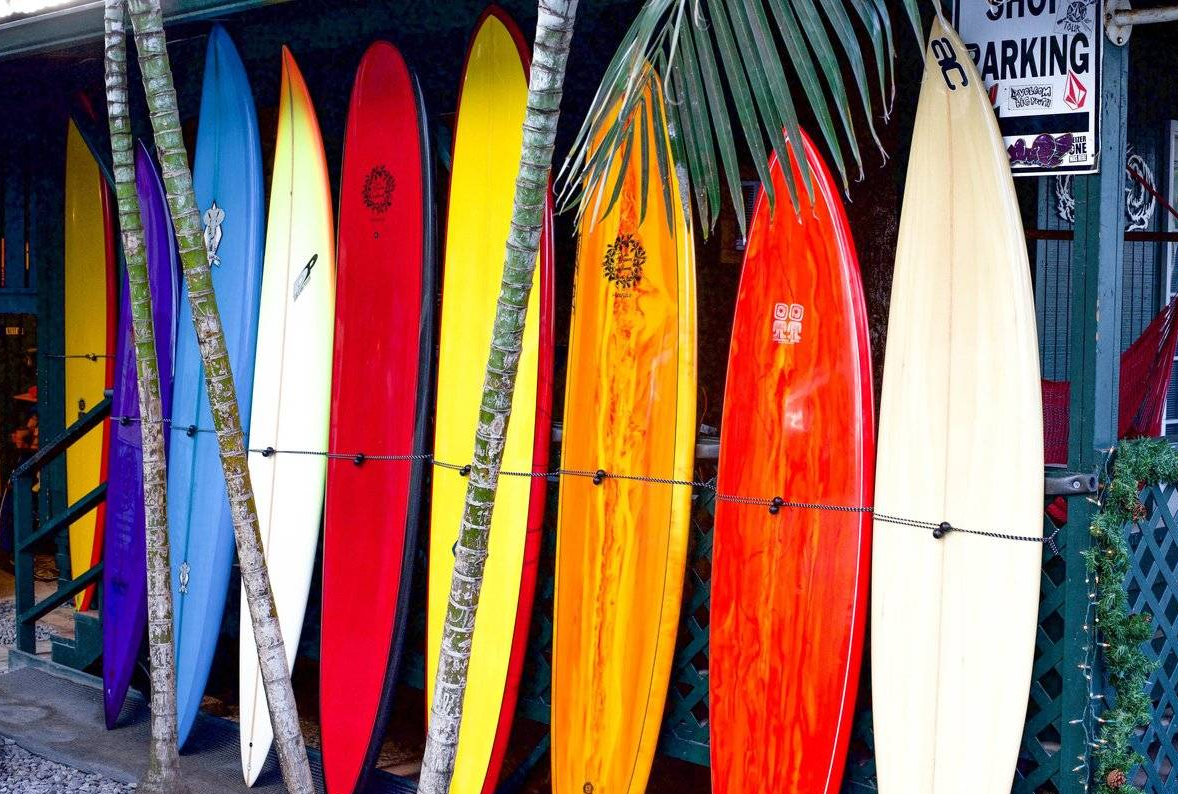
A six-foot shortboard and a nine-foot longboard can catch the same wave, yet the experience will be entirely different. The shortboard demands precise positioning and timing. The longboard can pick up the swell earlier, glide through flatter sections and give its rider more time to get to their feet.
Length explains part of that difference, but not all of it. Two six-foot boards can behave nothing alike. A wide, flat fish may fly across weak surf that leaves a narrow, heavily rockered performance shortboard struggling to maintain speed.
Choosing a surf board means looking beyond its outline. Width, thickness, volume, rocker, rails and fins all influence how it paddles, catches waves and responds underfoot. What matters is finding a shape that works in the conditions you actually surf, not just the waves you hope to ride someday.
How Surfboard Design Affects Performance
Every surfboard involves trade-offs. Extra flotation makes paddling and catching waves easier, but carrying more foam than you need can compromise responsiveness. A flatter rocker helps maintain speed through weak sections, while increased nose rocker gives the board more clearance on steep drops.
Board designers balance these characteristics according to the intended riding style. Small changes in rail shape, bottom contours or foam distribution can produce noticeable differences, even between boards with similar dimensions.
The main features of surfboard design affect performance in different ways:
- Length: Influences glide, paddling efficiency and the space needed to complete turns.
- Width: Adds planing area and stability, although excessive width can slow rail-to-rail transitions.
- Thickness: Contributes to volume and determines where the board carries its flotation.
- Rocker: Controls how the board fits into the wave’s curve and responds during takeoffs and turns.
- Rails: Affect how the board grips, releases and moves through the water.
- Bottom contours: Direct water flow beneath the board, influencing lift, speed and turning characteristics.
Rail and bottom design deserve particular attention. Fuller rails carry more foam toward the edges and can feel more forgiving, while thinner rails generally allow more precise engagement with the wave face.
A single concave can generate lift and channel water beneath the board. Double concaves may help with rail-to-rail transitions, while a V-bottom can make a wider board easier to roll from one rail to the other. Their effects depend on placement, depth and the surrounding shape.
The Main Types of Surf Boards
Surfboard types overlap more than their names suggest. A modern mid-length may borrow features from traditional longboards and performance shortboards, while fish designs range from classic twin-fins to refined boards built for powerful surf.
Understanding these differences makes it easier to compare surfboard shapes without relying solely on the manufacturer’s category.
Longboards and Funboards
A longboard surfboard typically measures nine feet or more. Its extended waterline and generous planing area help it glide efficiently, catch suitable waves early and maintain momentum without constant pumping.
Traditional longboarding emphasizes smooth turns, trimming and footwork. Riders move along the deck to adjust their position, cross-step toward the nose or perform noseriding maneuvers when the wave and board allow. Not all longboards are built for the same approach. A heavy, single-fin log with a broad nose favors flowing lines and classic footwork. A lighter performance longboard with more rocker and a multi-fin setup offers a different turning response.
Longboards are particularly well suited to:
- Small to moderate waves with long, peeling sections.
- Early wave entry and relaxed cruising.
- Cross-stepping, trimming and traditional footwork.
- Surfers who prefer flowing lines over rapid directional changes.
Their size becomes less convenient on land and in the lineup. Carrying a nine-foot board through crowded areas takes care, and controlling its momentum in powerful surf requires experience.
A funboard bridges the gap between a longboard and a shortboard. Commonly around seven to eight feet long, it retains useful paddling efficiency while offering a more manageable turning radius. Many funboards feature rounded noses, moderate rocker and enough width to support developing surfers. They are often a practical choice for riders who can catch unbroken waves but still benefit from extra stability.
The category is broad. A narrow seven-foot egg and a wide eight-foot mini-malibu may both be marketed as funboards, despite differences in their outlines, rails and handling.
Shortboards and Fish Boards
Performance shortboards prioritize responsive turning and control in steeper sections. Many contemporary models fall roughly between 5’6″ and 6’6″, although the appropriate dimensions vary with the rider and intended conditions.
Their narrower outlines, thinner rails and compact dimensions allow experienced surfers to perform tight bottom turns, snaps, cutbacks and aerial maneuvers.
That responsiveness comes at a cost. A conventional high-performance shortboard generally needs more precise positioning and stronger paddling than a larger board. It also relies on suitable wave energy or active speed generation to maintain momentum.
A fish takes a different approach.
Traditional fish surfboards are short, wide and relatively flat, usually with a swallow tail and twin-fin setup. Their broad planing area helps them carry speed through soft sections, making them appealing for smaller, less powerful waves.
Classic keel-fin fish boards favor drawn-out lines and flowing turns. Modern performance fish designs may use narrower tails, refined rails or alternative fin setups to improve control in faster surf. The distinction matters. A wide, flat traditional fish can feel less controlled in steep, hollow waves, while a more refined performance fish may handle those conditions effectively. Despite their generous width, fish boards are not automatically suitable for beginners. Their short length and relatively loose handling can make takeoffs and directional control challenging.
Understanding Surfboard Dimensions
Manufacturers normally list surfboard dimensions as length, width and thickness, followed by volume in liters.
A specification of 6’4″ × 20 1/2″ × 2 5/8″ describes a board measuring six feet four inches long, twenty and a half inches wide and two and five-eighths inches thick.
These measurements help narrow the options, although surfboard sizes alone cannot tell you how a particular shape will perform.
Length, Width and Thickness
Length affects how a board moves through the water. Longer designs tend to glide more efficiently at paddling speeds, while shorter ones can change direction more quickly when their other characteristics support that response.
Width influences both stability and planing area. A broad nose and chest section can support paddling and wave entry, while the width carried through the tail affects how the board releases and turns.
A wide tail tends to provide more lift and speed in softer surf. A narrower tail reduces planing area and can improve control when the rider applies pressure in powerful waves.
Thickness determines how much foam the board carries, but where that foam sits is equally important.
A board with thick, full rails may float and respond differently from one with a pronounced central thickness and thinner edges. Even with similar overall volume, the two shapes can have noticeably different rail engagement and paddling characteristics.
Volume and Buoyancy
Surfboard volume measures the space occupied by the board, expressed in liters. For boards of similar construction, greater volume generally provides more flotation, helping the rider sit higher in the water and paddle with less effort.
Volume is especially useful when comparing boards within the same category, but it does not tell you how that flotation is distributed.
Consider two hypothetical designs:
| Board | Dimensions | Approximate volume |
| Performance shortboard | 6’0″ × 19″ × 2 3/8″ | 28–30 L |
| Wide hybrid | 6’0″ × 21″ × 2 3/4″ | 38–42 L |
These figures are illustrative. Actual volume depends on the full shape, including rail thickness, nose, tail and bottom contours.
The hybrid carries considerably more foam and planing area. It will generally provide more flotation, while the narrower shortboard may offer quicker responses in suitable conditions.
Yet two boards with identical volume can also feel very different. A compact 40-liter fish distributes its foam across a shorter, wider outline, whereas a 40-liter mid-length may have a longer waterline and narrower profile.
The mid-length may glide more efficiently while paddling, while the fish can feel quicker to redirect in certain waves.
Surfer weight, fitness, paddling ability and preferred conditions all influence the volume required. Manufacturer calculators offer a starting point, but no single volume-to-weight ratio works for everyone.
Choosing a Surf Board for Your Skill Level
A good board should help you develop the skills you are currently working on. Downsizing too early often means fewer waves, rushed takeoffs and less time practicing turns.
For beginners, stability and predictable handling matter more than maneuverability.
A beginner surfboard around eight to nine feet long, usually with a soft-top construction, is a common starting point for adults learning in gentle surf. The exact dimensions depend on body weight, height, mobility and local conditions.
The soft deck also makes minor impacts generally less severe than those involving a comparable hardboard, although fins, collisions and the board’s weight remain hazards.
Once a surfer can consistently catch unbroken waves, angle their takeoff and travel down the line, a funboard, egg or mid-length may provide the next challenge.
A gradual transition makes more sense than choosing the smallest board available. Moving from an eight-foot soft-top to a seven-foot mid-length, for example, can introduce more responsive turning without sacrificing too much paddling efficiency.
Before switching, consider what your current board is actually holding you back from doing. If you can already catch waves reliably but struggle to fit the board into tighter turns, a shorter shape may help. If catching waves remains inconsistent, reducing length and volume is unlikely to improve matters.
Experienced surfers often keep different boards for different conditions rather than relying on one design year-round.
Matching Your Board to Wave Conditions
Wave shape matters as much as height. A slow point break with long shoulders rewards different equipment from a steep beach break with fast, hollow sections.
| Wave conditions | Common board choices | Main advantage |
| Small, gently breaking surf | Longboard, soft-top, mini-mal | Glide and earlier wave entry |
| Small, weak waves | Fish, groveler, wide hybrid | Speed through flat sections |
| Moderate, clean waves | Funboard, mid-length, hybrid | Versatile handling |
| Steep, powerful waves | Performance shortboard, suitable step-up | Control and responsiveness |
| Large, fast-moving waves | Specialized step-up or gun | Paddling and hold in demanding surf |
These combinations are guidelines rather than fixed rules. A skilled surfer can make a shortboard work in small waves or ride a longboard in powerful conditions.
The key is matching the board’s characteristics to the break, the rider’s ability and the kind of turns they want to make.
Surfboard Construction and Materials
Surfboard materials influence weight, flex, durability and repair requirements. Two boards with similar dimensions can feel different underfoot because of their cores, laminates and reinforcement.
Most hardboards use a shaped foam core covered with fiberglass and resin. The foam provides the board’s shape and much of its volume, while the fiberglass-and-resin laminate forms a protective, load-bearing shell.
Polyurethane (PU) foam with polyester resin
remains common in traditional surfboard manufacturing. It allows precise shaping and produces a familiar flex response. Pressure dents and cracks are relatively common forms of damage, particularly on lightly glassed performance boards.
Expanded polystyrene (EPS) foam with epoxy resin
is another widespread combination. EPS cores are often lighter for a given design, while epoxy laminates can offer favorable strength-to-weight characteristics.
Neither construction is automatically superior. Foam density, fiberglass weight, reinforcement and manufacturing methods affect how the finished board performs.
EPS foam also requires compatible resin. Conventional polyester laminating resin can damage exposed polystyrene, making material identification important before repairs.
Some manufacturers use molded shells, alternative cores or composite reinforcements to modify weight, flex and durability.
A foam surfboard, commonly called a soft-top, typically combines a buoyant core with a softer outer deck and other structural layers. Its forgiving surface and stable shape make it popular in surf schools.
Smaller soft-top models also have a place in recreational surfing, particularly for playful sessions in small, mellow waves.
Fins, Rocker and Tail Shapes Explained
Once you can comfortably ride down the line, the finer details of surfboard performance become easier to recognize.
Fins influence how firmly a board holds its direction, rocker affects how it fits into a wave, and the tail helps determine how pressure is transferred through turns.
Surfboard Fins and Fin Setups
Surfboard fins provide directional stability and resist sideways movement. Their size, rake, foil, placement and angle influence how a board turns and releases.
Common configurations include:
- Single fin: Associated with traditional longboards, offering smooth, flowing turns and controlled trimming.
- Twin fin: Common on fish and other loose, fast designs, often favoring flowing lines.
- Thruster: Three fins arranged with two side fins and a rear center fin, providing a versatile balance of drive, hold and turning control.
- Quad: Four fins in two pairs, capable of combining speed and hold depending on their placement.
- 2+1: A larger center fin with two smaller side bites, frequently used on longboards and mid-lengths.
Fin design matters as much as the number installed. Large keel fins on a traditional fish create a different response from upright twins, which generally allow tighter directional changes.
A thruster with smaller fins may feel looser than the same board fitted with larger, more swept-back fins.
Many modern boards use removable fins. Before purchasing replacements, check that the fin bases match the installed box system.
Rocker and Tail Design
Rocker is the lengthwise curve running from the nose to the tail.
A flatter rocker helps a board glide and maintain speed in weaker waves. More nose rocker provides clearance on steep drops, while tail rocker influences how tightly the board can pivot and fit into the wave face.
The correct amount depends on the intended conditions. Excessive rocker can create drag in soft surf, while a very flat board may be difficult to control during critical takeoffs.
Tail design further shapes the turning response.
- A squash tail provides a versatile balance of planing area and maneuverability, making it common on shortboards.
- A round tail creates a continuous outline that supports smooth rail transitions.
- A pin tail narrows toward the rear, reducing planing area and helping the rail remain engaged during high-speed turns in powerful surf.
- The swallow tail, familiar from fish boards, retains useful width while creating two distinct tips. Its handling depends heavily on the surrounding outline, rails and fins.
How to Maintain and Store a Surfboard
Good surfboard maintenance starts with preventing water damage, excessive heat exposure and unnecessary impacts. Regular inspection can stop a minor ding from becoming an expensive repair.
Rinse the board with fresh water after surfing when practical, paying attention to fin boxes, leash plugs and removable hardware. Check the nose, rails, tail and underside for damage.
Any crack that exposes the foam should be repaired before the next session. Water entering the core can add weight, weaken the structure and make repairs more difficult.
Wax buildup can be removed periodically with a suitable scraper and cleaning method. Avoid solvents unless they are compatible with the board’s materials.
Heat is another common problem. Leaving a board inside a closed car or exposed to strong sunlight for extended periods can damage the foam, resin or laminate.
Store boards in a cool, shaded place, ideally on a secure rack. A padded bag protects against knocks during transport, although a board can still overheat inside one.
Check removable fins and their fastening systems before entering the water. Inspect the leash, swivels and attachment points for wear, replacing damaged components promptly.
For repairs, identify the board’s construction first. PU/polyester and EPS/epoxy boards may require different materials, and using incompatible resin can cause further damage.
A little maintenance will not prevent every pressure dent, but it can keep a well-made surfboard in service for years.
FAQ
What type of surfboard is best for a beginner?
A large soft-top longboard is usually a practical starting point. Its generous dimensions make paddling, balancing and practicing takeoffs more manageable. The correct size depends on the surfer’s weight, mobility and local conditions.
Is a longer surfboard easier to ride?
A longer board generally offers better glide and can make catching waves easier, provided its width, volume and rocker suit the rider. Stability also depends on the outline and distribution of flotation, not length alone.
What does surfboard volume mean?
Volume is the amount of space a surfboard occupies, measured in liters. It helps indicate flotation but cannot fully predict paddling efficiency or maneuverability. Two boards with the same volume may behave differently because of their outlines, rocker and foam distribution.
What is the difference between a fish and a shortboard?
A traditional fish is generally wider and flatter than a conventional performance shortboard. It favors speed and flowing turns in softer surf, while a performance shortboard is typically designed for more precise maneuvers in steeper waves. Modern performance fish designs can blur that distinction.
How do I know when to switch to a smaller surfboard?
Consider downsizing when you can consistently catch unbroken waves, control your takeoff direction and link basic turns. Moving gradually to a forgiving mid-length or hybrid usually provides a more manageable transition than switching immediately to a low-volume performance shortboard.