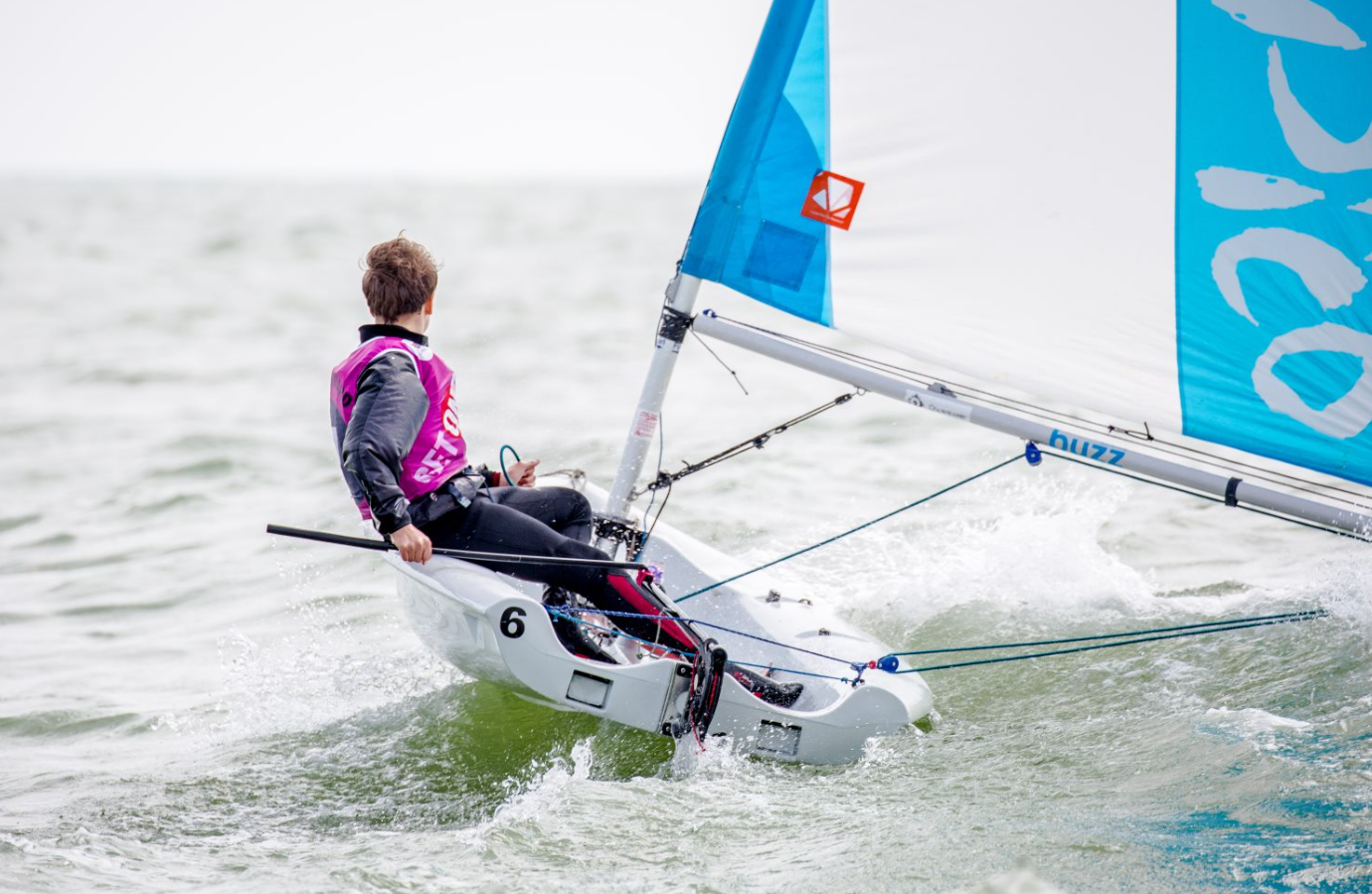
A sailboat doesn’t always travel in the direction its bow points. Wind pressure creates sideways force, the keel resists leeway, and current can carry the hull away from its intended track. Even a short passage across a bay calls for constant adjustments to keep the boat moving efficiently.
A sudden wind shift can alter the boat’s balance within seconds. It may heel more sharply, lose speed or develop weather helm. The sailor needs to recognize what’s happening and respond through steering, sail trim or weight distribution.
These principles matter just as much on a weekend cruise as they do in a championship race. Competitive sailing, however, introduces further demands: choosing the fastest route, managing traffic, interpreting racing rules and anticipating changes before rivals can exploit them.
Sailing as a Sport and Competitive Discipline
Sailing ranges from single-handed dinghy racing to offshore competitions involving large yachts and professional crews. Each discipline places different demands on its sailors. A dinghy racer may spend much of a race hiking to keep the boat upright, while an offshore crew must manage navigation, sail changes and fatigue over extended periods.
Unlike a powered vessel, a sailboat cannot increase speed simply by opening the throttle. Performance depends on wind conditions, hull design, sail efficiency and the sailor’s ability to limit drag.
That combination makes sailing both physically demanding and technically complex. Small adjustments to sail shape, heading or crew position can have a measurable effect on speed, particularly when competitors are racing closely matched boats.
How Wind Powers a Sailboat
Sails generate aerodynamic force as air moves around their curved surfaces. The resulting force depends on sail shape, angle to the apparent wind and airflow conditions. Only part of it contributes to forward motion; another component pushes the boat sideways and creates heeling force.
The keel, centerboard or daggerboard generates hydrodynamic side force that helps resist leeway. Together with the hull and rudder, these underwater surfaces influence how efficiently the boat converts wind power into movement.
Sailors distinguish between two important wind measurements:
- True wind: Wind relative to the water, as experienced by a boat stationary in the water. It differs from ground-referenced wind when current is present.
- Apparent wind: The airflow experienced aboard a moving boat, determined by the combination of true wind and the boat’s motion through the water.
As a boat accelerates across the wind, the apparent wind generally shifts forward. This effect becomes particularly noticeable on high-performance dinghies and racing yachts, where sail settings must respond to changes in boatspeed as well as wind direction.
Understanding apparent wind is essential for efficient trimming. The sails respond to the airflow they actually encounter, not simply the direction measured by a stationary observer.
Sailing techniques become more effective when the sailor understands how changes in boatspeed alter apparent wind and, in turn, the sail settings needed to maintain efficient airflow.
Sailing Skills, Techniques and Boat Handling
Good boat handling starts with maintaining speed and balance. Steering matters, but constant rudder corrections cannot compensate for poorly trimmed sails. On most boats, smooth inputs produce better results than abrupt changes of course.
Crew positioning plays a major role in smaller boats. Moving weight to windward counteracts heeling, while shifting forward or aft changes the hull’s trim in the water. Larger keelboats rely more heavily on sail controls, ballast and coordinated crew movements.
Core sailing skills include:
- Holding a steady heading without unnecessary rudder movement.
- Adjusting sails as the apparent wind angle changes.
- Managing crew position to maintain efficient hull trim.
- Carrying momentum through tacks and gybes.
- Recognizing gusts, lulls and changes in wind direction.
- Coordinating maneuvers through clear crew communication.
Sailing for beginners usually starts in moderate conditions, with steering, basic sail handling and controlled turns. Advanced training places greater emphasis on precise trimming, acceleration, tactical positioning and consistent performance across different wind strengths.
Understanding Wind Direction and Sailing Angles
A sailboat cannot sail directly into the wind. Its sails need a workable angle to the airflow, and that angle changes as the boat turns. Choosing the right course involves balancing distance traveled against the speed the boat can maintain.
The shortest route is not always the quickest. Sailing slightly farther at a more efficient angle may produce better progress toward a destination, especially in light winds or on high-performance boats.
Wind Direction and Points of Sail
Points of sail describe a boat’s heading relative to the true wind. Each requires a different sail setting and produces distinct handling characteristics.
| Point of sail | Heading relative to wind | Typical sail position |
| In irons | Bow pointing into the no-go zone | Sails luff; little or no forward drive |
| Close-hauled | As close to the wind as the boat can sail effectively | Sails trimmed relatively tightly |
| Close reach | Wind forward of the beam | Sails eased slightly |
| Beam reach | Wind approximately 90° from the bow | Sails eased farther |
| Broad reach | Wind coming from behind the beam | Sails eased substantially |
| Running | Wind approximately astern | Sails set for downwind sailing |
Many conventional monohulls sail close-hauled at approximately 35–50 degrees to the true wind. The achievable angle varies with hull design, sail configuration, sea state and leeway.
Reaching a destination directly upwind requires tacking between port and starboard courses. Each leg allows the boat to maintain forward drive while gradually gaining distance to windward.
Downwind performance presents another challenge. On a direct run, apparent wind strength decreases as the boat approaches true wind speed. Faster boats may make better progress toward a downwind mark by sailing at an angle and gybing, rather than following the shortest possible line.
Sail Trim and Boat Balance
Sail trim determines how effectively the rig produces drive at a given apparent wind angle. Sheets primarily control sail position, while other adjustments influence draft, twist and tension.
Overtrimming is a common mistake. Pulling a sail too tightly can increase drag and heeling force without improving forward speed. A practical starting point is to ease the sail until it begins to luff, then trim just enough to restore smooth airflow.
Several controls affect sail shape and performance:
- Mainsheet: Controls boom position and, depending on the setup, leech tension and twist.
- Traveler: Adjusts the boom’s lateral position, allowing more independent control of mainsail angle and leech tension.
- Outhaul: Controls fullness in the lower mainsail.
- Cunningham: Adjusts luff tension and helps control draft position.
- Halyard: Hoists the sail and influences luff tension.
- Vang or kicker: Limits boom rise and controls mainsail twist, particularly when the mainsheet is eased.
These controls interact, and not every boat carries the same equipment. A change that improves performance in flat water may be less effective in waves or stronger wind.
Excessive heel can increase drag, change the helm’s response and make the boat harder to control. Flattening the sails, increasing twist, moving crew weight or reefing can restore balance when conditions demand it.
The best trim delivers forward drive without excessive heel or drag.
Essential Sailing Maneuvers
Changing direction under sail requires coordinated steering, sail handling and weight movement. A poorly executed turn can leave a dinghy stalled head-to-wind or allow the boom to cross the cockpit unexpectedly.
The two fundamental turning maneuvers are tacking and jibing. Both change the boat’s tack, but the direction of the turn and the handling risks differ.
Tacking and Jibing
Tacking turns the bow through the wind. It is the standard maneuver for changing direction while sailing upwind.
A controlled tack involves five steps:
- Check the intended course for other boats and obstacles.
- Inform the crew and confirm readiness.
- Turn smoothly toward the wind while maintaining momentum.
- Release the old headsail sheet and trim the new one as the sail crosses.
- Settle onto the new course and accelerate.
Turning too slowly may leave the boat stuck in irons. An excessively sharp turn wastes speed through rudder drag and can disrupt crew movements.
Jibing, also called gybing, turns the stern through the wind. The mainsail moves from one side to the other as the wind crosses the stern.
On boats with conventional booms, uncontrolled jibing can be dangerous. The boom may swing across the cockpit with considerable force, particularly in stronger winds. The crew must manage mainsail movement, stay clear of the boom and mainsheet, and coordinate the turn.
In racing, every maneuver costs time. Even a clean tack briefly reduces speed, making smooth steering and quick acceleration essential when boats are separated by only a few lengths.
Steering and Speed Control
The rudder generates hydrodynamic force to change the boat’s direction. Large or frequent corrections also create drag, so experienced helmsmen generally favor small, deliberate movements.
Steering technique changes with wind conditions. When sailing close-hauled, a favorable wind shift may allow the boat to head higher while maintaining speed. In a lull, bearing away slightly can help preserve momentum.
Racers often distinguish between two sailing modes:
- High mode: Prioritizes pointing closer to the wind, sometimes at the expense of boatspeed.
- Fast mode: Favors acceleration and speed by sailing slightly lower.
Neither mode is universally faster. The right choice depends on waves, wind strength, the boat’s performance characteristics and tactical position.
Starts require particularly careful speed control. Sailors may ease sails or alter their heading to avoid crossing the line early, but they must leave enough time and space to accelerate before the starting signal.
Different Types of Sailing Competitions
Sailing competitions vary in distance, boat type, scoring and tactical demands. Some take place on compact courses with frequent maneuvers, while others cover hundreds or thousands of nautical miles.
A successful crew must understand the format of the event as well as the characteristics of its boat. Short-course racing rewards precise positioning and rapid decisions; offshore competition adds navigation, weather routing and endurance.
Sailing Races and Competition Formats
Fleet racing, match racing and team racing describe different competitive structures. Offshore racing concerns the type of course, while handicap racing refers to a method of comparing boats with different performance characteristics. These categories can overlap.
| Format | Main characteristics | Primary competitive challenge |
| Fleet racing | Multiple boats compete on the same course | Positioning, speed and fleet management |
| Match racing | Two boats compete directly | Controlling an opponent through tactics and rules |
| Team racing | Teams compete for a combined result | Coordinated positioning and tactical cooperation |
| Offshore racing | Long-distance courses through changing conditions | Navigation, endurance and weather strategy |
| Handicap racing | Results adjusted under a rating or time-correction system | Performance relative to the applicable handicap |
One-design racing restricts equipment differences within a class, placing greater emphasis on sailing technique and crew performance. Handicap racing allows different designs to compete using an established rating system.
Many short-course regattas use windward-leeward layouts with repeated upwind and downwind legs. Coastal races may include reaching sections, navigational marks and changing current, while offshore courses introduce broader weather decisions.
Sailboat racing therefore involves more than choosing the fastest vessel. Competitors must understand the scoring format, the course and the performance characteristics of their class.
Racing Rules and Right of Way
Organized sailboat racing generally follows the Racing Rules of Sailing published by World Sailing, together with applicable class rules, national prescriptions and event documents.
The sailing rules determine which boats must keep clear, when room must be provided and how competitors handle incidents, protests and penalties.
Several principles are particularly important:
- On opposite tacks, a port-tack boat generally must keep clear of a starboard-tack boat.
- On the same tack, a windward boat generally must keep clear of a leeward boat.
- When boats are on the same tack and not overlapped, a boat clear astern generally must keep clear of a boat clear ahead.
- When a right-of-way boat changes course, it generally must give the other boat room to keep clear.
- Mark-room rules may require a boat to provide another with space to round or pass a course mark.
These principles are subject to additional rules and exceptions. Overlaps, the zone around a mark, tacking and starting situations can all affect their application.
Right of way does not give a boat unlimited freedom to maneuver. Competitors must understand their obligations before changing course or approaching another vessel.
The current Racing Rules of Sailing edition covers 2025–2028. Sailors should also review the notice of race, sailing instructions and class requirements for each event.
Sailing Tactics and Race Strategy
Boatspeed alone rarely decides a closely contested race. A sailor may have excellent straight-line performance yet lose places through a poor start, an unfavorable wind shift or prolonged sailing in disturbed air.
Strategy concerns the overall route and the conditions likely to favor it. Tactics deal with immediate decisions involving other boats, available space and positioning.
Upwind racing often revolves around wind shifts. A persistent shift can make one side of the course more advantageous, while oscillating shifts create opportunities to gain by changing tacks at the right moments.
Sailing on the lifted tack may improve progress toward the windward mark, but the best decision also depends on expected shifts, current, waves and fleet position.
Before the start, crews commonly assess:
- Wind direction and the pattern of recent shifts.
- Stronger and weaker wind areas across the course.
- Current and its effect on the boat’s track over the ground.
- Starting-line bias and likely congestion.
- The preferred approach to the first mark.
A strong start combines accurate timing, acceleration and access to clear air. Crossing the line at speed is valuable, but an apparently favorable position can quickly become a disadvantage if it forces the boat toward the wrong side of the course.
Disturbed airflow from nearby competitors can reduce both speed and pointing ability. Tacking into clear air may therefore be worthwhile, even when it means temporarily giving up a preferred route.
Downwind tactics depend on wind pressure, sailing angles, gybe timing and nearby traffic. Boats using asymmetric spinnakers may gain substantially by choosing a faster angle rather than sailing directly toward the mark.
Risk also shapes racing decisions. A leading boat may protect its position and avoid unnecessary separation, while a trailing competitor may need a more aggressive route to recover places.
Physical Fitness and Training for Sailors
Wind provides propulsion, but competitive sailing can place considerable demands on the body. The workload depends on the boat, the weather and the sailor’s role aboard.
In hiking dinghies, sailors lean their upper bodies outboard, using their legs and core muscles to counteract heeling forces. Trapeze sailing adds demands on balance, coordination and sustained muscular control.
On larger racing yachts, crew members handle loaded sheets, grind winches, move sails and work on unstable decks. Offshore sailors must also manage fatigue and maintain concentration during long periods at sea.
Sailing training should reflect these different demands. Core stability, leg endurance, pulling strength and cardiovascular conditioning are common priorities. Mobility around the hips, shoulders and spine supports efficient movement and may help reduce strain.
Physical preparation cannot replace time on the water. Boat handling improves through repeated practice under varied conditions, especially when exercises target specific weaknesses.
Useful drills include:
- Repeated tacks and gybes with attention to speed loss.
- Timed acceleration after turns.
- Mark roundings with controlled sail handling.
- Short practice starts focused on positioning and timing.
- Two-boat testing to compare speed and pointing angles.
Video footage and onboard instruments can help identify inconsistent steering, poor sail settings or unnecessary crew movements.
Practicing one maneuver repeatedly under comparable conditions makes improvements easier to measure. A sailor who can consistently tack without losing much speed gains an advantage that carries directly into racing.
Equipment Used in Competitive Sailing
Sailing equipment differs substantially between classes. A single-handed dinghy may use a relatively simple rig, while an offshore yacht carries multiple sails, navigation systems and specialized safety gear.
The essential components fall into three broad categories: propulsion and sail control, hull and steering systems, and crew protection.
Common equipment includes:
- Mainsail and headsail: Provide the primary sail area on many conventional boats.
- Mast, boom and rigging: Support the sails and maintain the rig’s configuration.
- Keel or centerboard: Resist leeway, with stability characteristics depending on the design.
- Rudder: Provides directional control.
- Sheets and control lines: Adjust sail position and shape.
- Personal flotation devices: Provide buoyancy and are an important part of sailing safety.
- Harnesses and trapeze systems: Allow crew members to position their weight effectively on suitable boats.
Some racing boats carry spinnakers for downwind sailing. Symmetrical spinnakers commonly use a pole, while asymmetric designs are often flown from a bowsprit or suitable tack point. Their handling and effective wind angles differ.
Electronic instruments may display boatspeed, heading, depth and wind information. Advanced systems can calculate performance targets or provide tactical data, although their use may be restricted by class or event rules.
Equipment condition matters more than complexity. Damaged sails, worn control lines or poorly maintained steering systems can undermine performance regardless of how sophisticated the boat’s electronics are.
Before racing, crews should inspect rigging, sail condition, control systems, steering and required safety equipment. Class-specific measurement and equipment rules also need attention.
FAQ
What are the most important sailing skills for beginners?
Beginners should learn to identify wind direction, steer a steady course, trim sails and complete controlled tacks and gybes. Stopping safely, recovering from a capsize where relevant, and returning to shore are equally important. Supervised practice in manageable conditions provides the best foundation.
What is the difference between tacking and jibing?
Tacking turns the bow through the wind, while jibing turns the stern through it. Tacking is commonly used on upwind courses; jibing is used when changing direction downwind. Both move the boat from one tack to the other, but jibing requires particular care because the boom can cross the cockpit rapidly.
How can sailors improve their racing performance?
Consistent practice and performance measurement are more useful than relying on impressions. Comparing boatspeed and pointing against a similar boat, improving starts and reducing speed loss during maneuvers can produce meaningful gains. Reading wind shifts and finding clear air are equally valuable racing skills.
What rules apply in competitive sailing?
Most organized races follow the World Sailing Racing Rules of Sailing, supplemented by applicable class rules, national prescriptions and event documents. The 2025–2028 edition covers keeping-clear obligations, mark-room, starting procedures, protests and penalties. Competitors should review the rules and sailing instructions before each event.
What safety equipment should sailors carry?
Requirements depend on the boat, sailing area and applicable regulations. Appropriate personal flotation, communication equipment and weather-resistant clothing are basic considerations. Offshore events may require liferafts, emergency beacons and distress-signaling devices.
Crews should also practice man-overboard recovery. The procedure includes immediately alerting others, maintaining visual contact with the person in the water, maneuvering for a controlled recovery and providing assistance once they are back aboard. Weather, tides, boat condition and crew capability should always be checked before departure.
The difference between competent sailing and consistent racing performance often comes down to decisions made before speed is lost. Reading a shift early, trimming for the next leg or completing a clean maneuver can save valuable seconds. With practice, those adjustments become more precise, whether the sailor is handling a dinghy for the first time or competing in a demanding regatta.